
 Call us now:

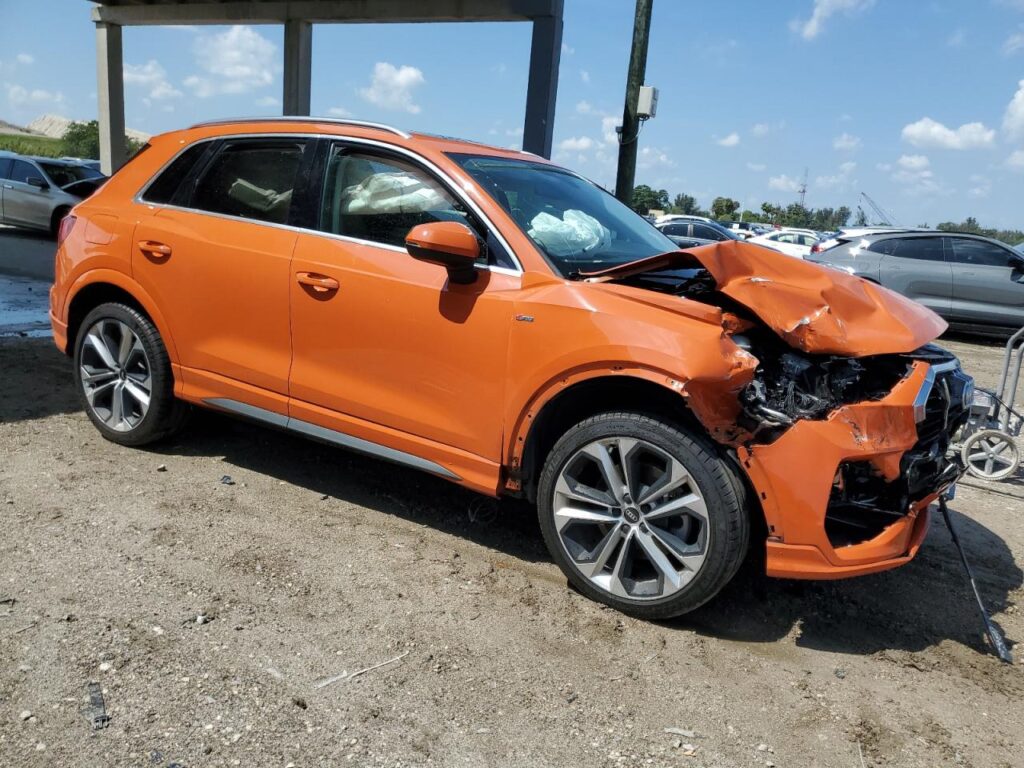
When a vehicle is declared a total loss, the insurer’s initial offer is rarely the final word. In Florida, policyholders have a built-in right under their own insurance policy to challenge that number through a process called the appraisal clause , and this case study walks through exactly how that process worked for a 2021 Audi Q3 45 S Line Premium Quattro in Lake Worth.
The insurer’s base vehicle value came in at $20,965. Our independent appraisal established a value of $25,785. The final appraisal award, signed by both appraisers, settled at $25,382 , a recovery of $4,417 above the insurer’s base offer.
What follows is a detailed look at how we got there, why the insurer’s valuation methodology left money on the table, and what the appraisal clause process looked like from start to finish.
Case Overview
| Vehicle | 2021 Audi Q3 45 S Line Premium Quattro |
| Exterior | Pulse Orange |
| Engine | 2.0L Turbocharged Inline-4, AWD |
| Location | Lake Worth, FL |
| Service | Independent total loss appraisal / appraisal clause |
| Insurer’s base vehicle value | $20,965 |
| Auto Praise independent appraisal | $25,785 |
| Final appraisal award | $25,382 |
| Recovery above insurer’s base offer | $4,417 |
Florida Total Loss Appraisal & Claim Support
- Professional Authority: I-CAR Platinum & IACP Certified Appraisers with Florida 6-20 Adjuster Licensing.
- Industry Credentials: Over 30 years of specialized automotive and insurance claims experience.
- Valuation Experts: Independent Actual Cash Value (ACV) reports designed to accurately value your vehicle.
- Proven Reputation: Five-Star Rated Florida independent appraisal firm providing statewide remote and mobile support.
What Is the Appraisal Clause and Who Can Use It?
The appraisal clause is one of the most underused rights in any auto insurance policy , and one of the most valuable. In plain terms, it is a dispute resolution mechanism built directly into your policy that allows you, the vehicle owner, to challenge the insurer's total loss valuation by hiring your own independent appraiser.
Most people do not know it exists. Many who do know it exists assume it is complicated or adversarial. It is neither.
Before taking any formal steps, the single most important thing a vehicle owner can do after receiving a total loss offer is request a copy of the market valuation report from the insurer and have it reviewed by a certified independent appraiser. That review will tell you whether the methodology, comparable selection, mileage, and condition ratings used in the report are accurate , and whether the market data actually supports a different settlement number. There is no reason to make any decision about invoking the appraisal clause until that review has been completed. In many cases, the review itself identifies specific, documented issues that form the basis for a well-supported challenge.
For a detailed step-by-step walkthrough of how this process works, see our Total Loss Appraisal Clause guide. You can also download our Florida Total Loss Claim Guide for a complete overview of your rights from the moment your vehicle is declared a total loss.
Here is how the appraisal clause process works once a review confirms there is a valid basis to proceed:
Step 1 — Review your policy. The appraisal clause is typically found in the loss payment or general conditions section. It spells out your right to demand an independent appraisal if you disagree with the insurer's valuation.
Step 2 — Make a written demand. Once you and your appraiser have confirmed that the market supports a different value, you notify the insurer in writing that you are invoking the appraisal provision. This formally begins the process.
Step 3 — Each side selects an appraiser. You hire a qualified independent auto appraiser with no financial interest in the outcome. The insurer appoints their own appraiser.
Step 4 — The appraisers attempt to agree. In many cases, the two appraisers negotiate directly and reach an agreed value. If they cannot agree, they select a neutral third-party umpire whose decision becomes binding.
Step 5 — The award is signed. Once a value is agreed upon, both appraisers sign the appraisal award and that amount becomes the settlement.
One important point: invoking the appraisal clause does not make you adversarial with your insurer. It is a contractual right, not a lawsuit. You are simply using the mechanism your own policy provides to ensure the valuation is accurate.
How the Insurer's Valuation Was Constructed
The CCC ONE Market Valuation Methodology
Insurers across the country rely on third-party valuation software to generate total loss offers. One of the most widely used platforms produces what is called a Market Valuation Report , a document that presents a base vehicle value derived from a database of comparable vehicles currently or recently for sale in the area.
The methodology works like this: the software takes the vehicle's zip code, VIN, mileage, and condition, searches a proprietary database for comparable vehicles, makes adjustments to those comparables for differences in mileage and options, and produces a weighted average value. That weighted average becomes the base vehicle value , in this case, $20,965.
On the surface, it sounds rigorous. In practice, the output is only as reliable as the inputs and the comparable selection. And that is where the examination begins.
It is worth stating clearly: automated valuation tools are a legitimate starting point for total loss settlements. The issue is not that the methodology exists , it is whether the specific inputs and comparables used in a given report accurately reflect the market for that specific vehicle.
Comparable Vehicle Selection — What We Found
In this case, the valuation report identified eleven comparable vehicles used to establish the base value. Every single one of those comparables was located in Pompano Beach or Fort Lauderdale — none were pulled from Lake Worth, Boynton Beach, West Palm Beach, or the immediate surrounding market where this vehicle was garaged.
The software searches outward from the loss vehicle's zip code, typically within a 150-mile radius, and selects comparables based on proximity weighting, recency, and similarity. There is nothing inherently wrong with pulling comparables from South Broward County for a Palm Beach County vehicle — those markets are close enough to be considered local, and the inventory overlap is real.
What matters is whether the comparable vehicles themselves were truly equivalent to the loss vehicle. That is where the analysis deepens.
The Mileage Discrepancy
One of the more important details in the valuation report's audit trail is this: the mileage used in the original valuation was 36,000 miles. Mid-process, that figure was updated to 40,019 miles — the actual odometer reading at the time of loss.
Why does this matter? Mileage is one of the primary adjustment factors in any automated valuation. A 4,019-mile difference on a 2021 vehicle changes the mileage adjustment applied to each comparable and, by extension, the weighted base value. Higher mileage generally produces a lower value.
In our independent appraisal, we verified the actual odometer reading directly through physical inspection and cross-referenced it against the title history from the Florida Highway Safety and Motor Vehicles database. The reading used in our report was confirmed accurate.
This is a detail that is easy to overlook when reviewing a valuation report. It is also a detail that, if incorrect, can meaningfully shift the final number , in either direction.
VIN Matching — A Critical Detail Most People Miss
Every vehicle carries a 17-character Vehicle Identification Number that encodes the year, make, model, body style, engine, trim level, factory options, and country of manufacture. A single character difference in a VIN can mean the difference between a base-trim vehicle and a fully loaded premium trim , and in dollar terms, that difference can be several thousand dollars.
When an automated valuation system pulls comparable vehicles from its database, it searches by VIN structure, but the comparables it surfaces are only as accurate as the VIN decoding applied to both the loss vehicle and the comps. If the loss vehicle's VIN decodes to a premium trim but the comparables pulled are base or mid-trim variants of the same model, the resulting adjusted values will be suppressed.
In our process, we cross-reference the loss vehicle's VIN against three independent sources: the window sticker, which shows original MSRP, factory option codes, and trim designation; the CARFAX vehicle history report; and the FLHSMV title record. This triangulation ensures that every comparable we consider is genuinely equivalent, same trim, same drivetrain, same major option packages, not just the same model name.
For the 2021 Audi Q3 in this case, the vehicle was an S Line Premium trim with Quattro all-wheel drive, a meaningfully higher specification than the base Q3. Ensuring comparable vehicles matched that specification exactly was non-negotiable in building a credible independent appraisal.
For more on how insurance companies determine total loss value and where those valuations can fall short, see our detailed overview of the process.
Factory Color and Option Packages — When They Matter and When They Don't
The 2021 Audi Q3 in Pulse Orange is visually striking. It is a relatively uncommon color in the South Florida market, and vehicle owners sometimes assume that a rare or distinctive color adds value to their total loss settlement.
In this case, it did not, and we want to be transparent about why.
Pulse Orange was a standard factory color option on the 2021 Audi Q3, not a cost-option from the factory. Because it carried no additional MSRP premium, there was no basis for an upward value adjustment based on color. Our independent appraisal treated it accordingly.
That said, color can absolutely matter in total loss valuations under the right circumstances. Many manufacturers offer specialty paint programs that carry significant factory premiums. Porsche's exclusive paint-to-sample program can add $5,000 to $12,000 or more to the MSRP. BMW Individual colors regularly carry $4,000 to $6,000 premiums. Land Rover's premium palette options start around $4,000. When a vehicle carries one of these factory paint premiums and that premium is documented on the original window sticker, it belongs in the valuation analysis, and it belongs in the comparable selection criteria.
The principle is the same whether it is color, an equipment package, or a factory accessory: if the original manufacturer charged a documented premium for it, it should be reflected in both the loss vehicle's value and the comparables used to establish that value. If it was a standard no-cost option, it should not create an artificial adjustment in either direction.
The Auto Praise Independent Appraisal — Our Process
Physical Inspection at the Salvage Facility
I personally inspected this vehicle at the salvage facility. That is not a small detail.
Automated valuations are desktop exercises, they work from a VIN, a mileage figure, and condition inputs provided by someone else. An independent auto appraiser who physically inspects the vehicle works from firsthand documentation: the actual odometer reading, the real interior and exterior condition, the as-built configuration, and the photographic record that becomes part of the appraisal file.
At inspection, we documented the VIN plate, confirmed the odometer reading, assessed interior condition across seats, carpets, dashboard, and headliner, assessed exterior condition across all panels and glass, and photographed the vehicle from all angles. That documentation becomes part of the certified appraisal record, a record that is defensible, transparent, and produced under the Uniform Standards of Professional Appraisal Practice.
For a vehicle that has been in a significant collision and towed to a salvage yard, the condition assessment matters. Pre-loss condition directly affects the value opinion. A vehicle with documented regular maintenance, no prior damage history, and a well-maintained interior is worth more than a neglected one , and that difference should be reflected in the appraisal, not assumed away by applying a generic average condition adjustment.
Market Research — How We Built Our Value Opinion
With the physical inspection complete, we turned to market research. Our comparable selection process considered the following:
Trim equivalency. Every comparable had to match the S Line Premium Quattro specification. We did not include base Q3 or mid-trim variants.
Recency. Comparable listings were prioritized based on how recently they were active in the market. A listing from four months prior carries less weight than one from two weeks prior. The market for a specific vehicle can shift meaningfully in a few months, particularly in Florida where seasonal demand patterns are real.
Proximity and market relevance. We focused on comparable vehicles available within the South Florida market, cross-referencing both dealer listings and private market data to build a complete picture of what a knowledgeable buyer would pay for this vehicle in this market.
CARFAX history-based value cross-reference. The CARFAX history-based value for this vehicle, given its service history and ownership profile, provided an additional data point for calibration.
Window sticker review. The original manufacturer's window sticker for this vehicle was available and reviewed. It confirmed the original MSRP, the factory option codes, and the trim specification, ensuring our comparable selection was grounded in the actual as-built configuration of the vehicle.
FLHSMV title history verification. Florida Highway Safety and Motor Vehicles records confirmed the title history, ownership sequence, and odometer readings on record, providing independent verification of the vehicle's history profile.
The Valuation Summary
After completing the physical inspection, market research, comparable selection, and cross-referencing, our independent appraisal established a Fair Market Value / Actual Cash Value of $25,785.23 for the 2021 Audi Q3 45 S Line Premium Quattro as of the date of loss.
This appraisal was certified under the Uniform Standards of Professional Appraisal Practice. The certification of credibility attached to the report confirmed that the analysis was conducted independently, without predetermined conclusions, and without any financial interest in the outcome beyond the flat fee charged for the appraisal service.
The Appraisal Award — How the Process Resolved
With the appraisal clause formally invoked, both sides appointed their appraisers. Our appraisal established the vehicle's value at $25,785. The insurer's position was anchored to the $20,965 base value from the market valuation report.
The two appraisers worked toward an agreed value. Through that process, which is exactly what the appraisal clause is designed to facilitate, both parties reached an agreed number without the need for a neutral umpire.
The final appraisal award, signed by both appraisers, established the agreed actual cash value at $25,382.
That is $4,417 above the insurer's base vehicle value. It represents the difference between accepting the first offer and understanding your policy rights.
For more on how total loss settlement negotiations work and what to expect from this process, see our detailed breakdown. For the legal framework governing total loss claims in Florida, see our overview of Florida Total Loss Law.
What This Case Study Illustrates
Every total loss situation is different. The vehicle, the market, the valuation methodology, and the specific comparables used all vary from one claim to the next. But several principles hold true across cases.
Automated valuations are a starting point, not a conclusion. The software that insurers use is legitimate and widely applied. It is also a tool — and like any tool, its output depends on the quality of its inputs. Mileage accuracy, VIN decoding, comparable selection, and condition assessment all affect the result.
Physical inspection produces a defensible record. A certified appraiser who inspects the vehicle in person, documents the condition, and builds a market analysis from verifiable sources produces a report that can stand behind its conclusions. That is the standard we hold ourselves to at Auto Praise.
The appraisal clause is your right, not a confrontation. It is written into your policy. Using it is not aggressive — it is prudent. And in many cases, it closes a meaningful gap between what the insurer initially offers and what the vehicle was genuinely worth on the open market at the time of loss.
Details matter. Mileage discrepancies, VIN accuracy, factory option documentation, and comparable trim equivalency are not minor technicalities. Each one can meaningfully shift the final valuation, and each one deserves careful attention from anyone conducting an independent appraisal.
If you have received a total loss offer and want to understand whether the valuation reflects what your vehicle was actually worth, our post on what to do if your insurance company undervalued your car in a total loss is a good place to start. For a deeper look at how comparable vehicles are selected and weighted in total loss valuations, see our breakdown of comparable vehicles in total loss valuation.
Catching a mileage figure that moved from 36,000 to 40,019 mid-process, then holding every comparable to S Line Premium Quattro spec instead of a base Q3, is the kind of work a certified total loss appraisal is built around. Here it accounted for $4,417 over the carrier's base value.
Need Help With a Total Loss Settlement?
If the insurance company’s total loss offer seems too low, Auto Praise can review the market valuation report and identify errors that may be affecting your settlement amount. We assist Florida vehicle owners statewide by reviewing comparable vehicles, adjustments, options, condition ratings, and valuation methodology to determine whether the offer is accurate.
A free claim review can help you understand whether there is a valid basis to challenge the insurance company’s valuation and pursue a better settlement.
Call 754-210-9807 for a Free Review
Florida Licensed Adjusters • I-Car Platinum Certified Auto Physical Damage Appraisers • IACP Certified Auto Appraisers
Frequently Asked Questions
What is the appraisal clause in a Florida auto insurance policy?
The appraisal clause is a dispute resolution provision built into most Florida auto insurance policies that gives the vehicle owner the right to challenge the insurer's total loss valuation by hiring an independent appraiser. If the two appraisers cannot agree on a value, a neutral umpire makes the final determination. The process is contractual and is designed to ensure fair valuation when the parties disagree on the vehicle's worth.
What should I do first if I think my total loss offer is too low?
Request a copy of the market valuation report from your insurer and send it to a certified independent appraiser for review before taking any other steps. That review will identify whether the comparable vehicles, mileage, condition ratings, and methodology used in the report are accurate — and whether current market data supports a higher settlement. Making an informed decision based on a professional appraisal review is always the right first move. Auto Praise offers a free claim review for Florida vehicle owners and can walk you through what the report shows and what options are available to you.
What does an independent auto appraiser do in a total loss dispute?
An independent auto appraiser conducts a physical inspection of the vehicle, builds a market analysis using comparable vehicles, cross-references the VIN against the window sticker and title history, and produces a certified appraisal report establishing the vehicle's fair market value as of the date of loss. That report becomes the basis for the independent appraiser's position in the appraisal clause process and provides the documented support needed to pursue a different settlement figure.
How does mileage affect total loss value in Florida?
Mileage is one of the primary adjustment factors in any total loss valuation. Lower mileage than average for a vehicle's age typically supports a higher value; higher mileage supports a lower one. Because mileage adjustments are applied to each comparable vehicle in the analysis, an incorrect odometer reading can materially affect the base vehicle value. Verifying the actual odometer reading at the time of loss — and confirming it against the title history — is an essential step in any independent appraisal.
Does the color of my vehicle affect its total loss settlement value?
It depends on whether the color carried a factory MSRP premium. Standard palette colors, even uncommon or distinctive ones, typically do not create an upward value adjustment because they were not cost options at the time of original purchase. However, if your vehicle has a specialty factory paint that carried a documented premium on the original window sticker, that premium belongs in the valuation analysis. Manufacturer specialty paint programs — such as those offered by Porsche, BMW, and Land Rover — can add $4,000 or more to a vehicle's original cost, and that premium should be reflected in any credible independent appraisal.
What is a market valuation report and do I have to accept it?
A market valuation report is a document produced by third-party software that insurers use to establish a base vehicle value for total loss settlements. It is based on comparable vehicle data and applies mileage and option adjustments to arrive at a weighted average value. It is a legitimate starting point — but it is not the only methodology available, and its accuracy depends on the quality of its inputs and comparable selection. You are not required to accept the first offer. Having the report reviewed by a certified independent appraiser is the most effective way to determine whether the valuation is accurate and whether a different settlement is supported by the market.
How long does the appraisal clause process take in Florida?
The timeline varies depending on how quickly both sides appoint their appraisers and how smoothly the negotiation proceeds. In straightforward cases where both appraisers reach a direct agreement — as happened in this case — the process from demand to signed award can be completed in a few weeks. Cases that require a neutral umpire take longer. Throughout the process the claim continues to move forward, so invoking the clause does not necessarily stall everything — it determines the final number at which the claim resolves.
If you have questions about a total loss situation or want to understand whether an independent appraisal makes sense for your vehicle, I am happy to talk through the details. I have spent more than 30 years inside the automotive and insurance valuation process, first as an independent field appraiser and licensed adjuster, now exclusively working for vehicle owners. The goal is always the same: make sure the valuation reflects what your vehicle was actually worth.