
 Call us now:

This inspection summary and appraisal field report detail the legendary 1966 Ford GT40 MKII, specifically chassis XGT 3, which sold at Mecum Kissimmee 2026 for a staggering $12,375,000. Widely regarded as the most original example of the breed, this factory lightweight is a cornerstone of American racing history.
Summary
The 1966 Ford GT40 MKII Factory Lightweight chassis XGT 3 is one of the most historically significant American race cars in existence. As one of only three factory-built lightweight Mk II GT40s, and the most original surviving example, XGT 3 served as a backup car for Ford’s historic 1-2-3 finish at the 1966 24 Hours of Le Mans. Inspected in original condition at the Mecum Kissimmee 2026 auction, the car sold for $12.375 million, reflecting its unmatched originality, provenance, and value as a primary reference example of Ford’s Total Performance era racing program.
From the Inspector’s Desk: In the Presence of Greatness
Standing on the floor at Mecum Kissimmee 2026, I’ve seen my fair share of high-caliber steel, but laying eyes on XGT 3 was a career highlight. As a vehicle appraiser, you’re often looking for what has been changed, restored, or “corrected” over time. With this Ford GT40 MKII, the experience was the exact opposite.
Inspecting the cockpit, I was struck by the sheer lack of “modern” interference. Seeing the original G.Q. Parachute Co. harnesses still in place and the weathered Stewart Warner gauges felt like stepping directly into 1966. Most racing machines from this era are like an “Old Man’s Ax” they’ve had three new heads and four new handles. But here, the thin-gauge steel of the monocoque and the experimental AX 316 engine markings are exactly as Shelby’s team left them at the LAX facility.
The technical details I captured, from the specific transistor ignition labels to the Tachometer calibration chart taped to the dash speak to a level of “survivor” status that simply doesn’t exist elsewhere in the GT40 world. It isn’t just a car; it is a primary source document for American motorsport. To be the able to inspect and admire this chassis before it disappeared into another private collection for potentially the next several decades was a privilege.
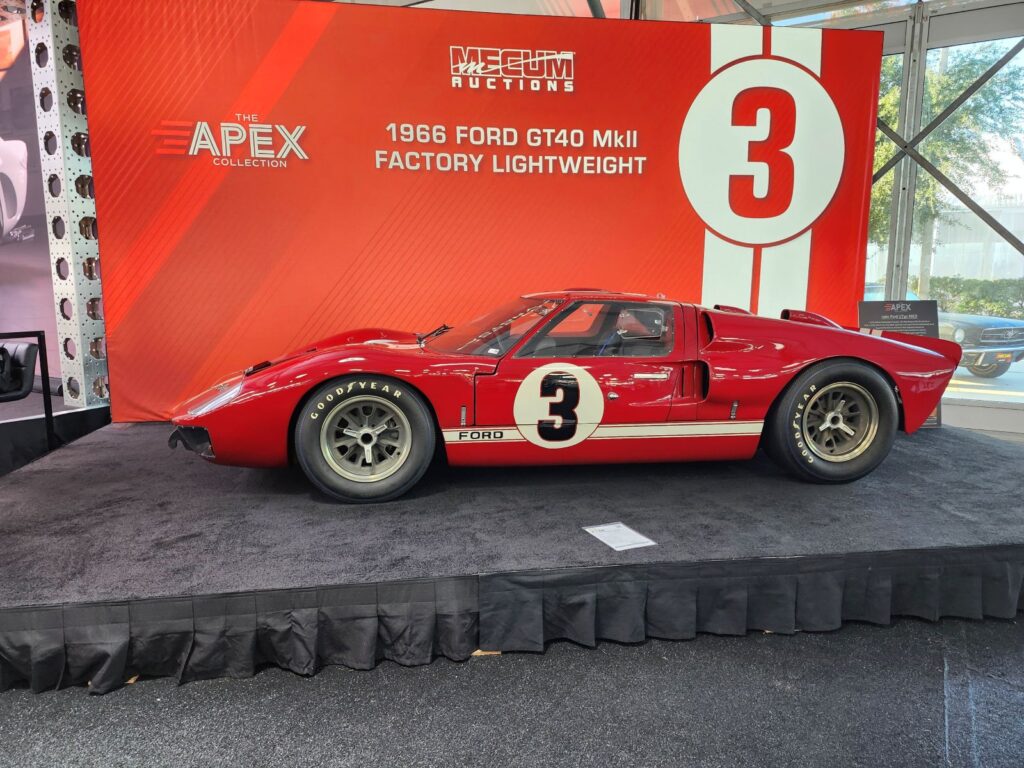
The Ultimate Survivor: 1966 Ford GT40 MKII Factory Lightweight
Chassis XGT 3 represents the pinnacle of the Ford “Total Performance” era. As one of only nine surviving MkII GT40s and one of just three factory-produced with an experimental lightweight chassis, its provenance is unparalleled.
While most MkIIs were restored to their former glory, XGT 3 is famous for being in its original configuration. Marque historian Ronnie Spain famously noted that while other cars are “fabulously restored,” only XGT 3 remains as it left the factory.
Provenance and Racing History
- Origin: Initially ordered by Alan Mann Racing and constructed by Shelby American at their LAX facility.
- Historical Significance: Served as a backup car for Ford’s historic 1 2 3 finish at the 1966 24 Hours of Le Mans.
- Custodianship: Retained by Ford Motor Company until 1977; it has seen only four private owners since.
- Marketing Icon: Because it was never raced, it was used by Ford for promotional tours and advertisements following the Le Mans victory.
Technical Specifications & Performance Specs
The Heart of a Giant: 427 CI FE V8
The Ford GT40 MKII was designed around the massive 427 cubic-inch (7.0L) V8 engine.
- Horsepower: Produces approximately 485 hp at 6,200 rpm.
- Induction: Features a single Holley 780 CFM 4-barrel carburetor.
- Experimental Components: The valve covers on XGT-3 bear the “Experimental” AX-316-1-50 engine number markings.
- Exhaust: Equipped with the signature “Bundle of Snakes” headers.
Drivetrain & Transmission
To handle the immense torque of the 427 big block, Ford utilized a specialized Kar Kraft T44 4 speed manual transaxle. This magnesium cased unit was designed specifically for the GT program to ensure reliability during 24 hour endurance cycles.
Classic Car Pre Purchase Inspections
Buying a classic or collector vehicle involves more than cosmetic appeal. A professional pre purchase inspection can help identify authenticity concerns, configuration issues, and condition factors before a purchase is finalized.
Learn more about our Classic Car Pre Purchase Inspection services
Condition & Component Inspection
Chassis and Bodywork
- Lightweight Construction: Built with experimental thin gauge steel for the monocoque and a specialized aluminum roof.
- Adjustable Suspension: XGT 3 features an adjustable suspension system a high performance feature exclusive only to the three lightweight chassis cars.
- Brakes: Period correct ventilated disc brakes with a quick change system.
Interior & Safety
The cockpit is a time capsule of 1960s racing technology:
- Layout: Right hand drive (RHD) with a right hand gear shifter (wood topped with “GT” logo).
- Instrumentation: Features a Jones Motrola mechanical tachometer (7,000 RPM redline) and Stewart Warner gauges for water, oil, and fuel pressure.
- Safety Gear: Retains the original blue G.Q. Parachute Co. Type “Z” harnesses and perforated black “parachute” seats for pilot ventilation.
Exterior Details
- Livery: Finished in Red with White Le Mans stripes and #3 roundels.
- Wheels: Original 15 inch Halibrand magnesium center-lock wheels wrapped in period correct Goodyear tires.
- Unique Features: The front trunk houses the Goodyear spare and factory Le Mans fuel crossover tanks.
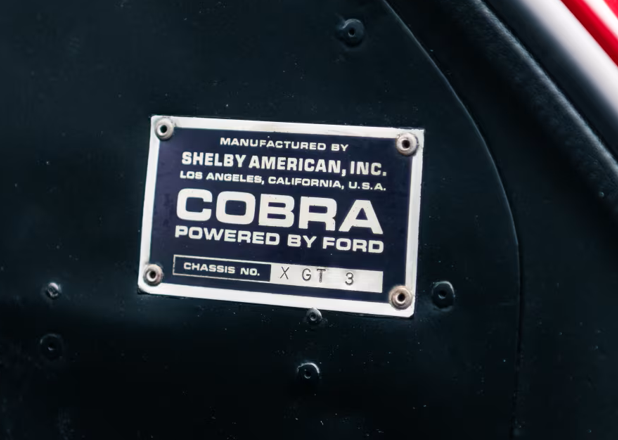
Based on my first-hand inspection of XGT 3 at the Mecum Kissimmee 2026 auction, the following technical details from the chassis plate and engine bay underscore its status as the most original Ford GT40 MKII in existence.
Chassis Plate & Provenance
The Shelby plate confirms this vehicle’s elite origin and technical specification:
Manufacturer: Shelby American, Inc., Los Angeles, California.
Model Designation: Labeled as “Cobra Powered by Ford”.
Chassis Number: XGT 3, identifying it as one of only three factory lightweight examples ever built.
1966 Ford GT40 MKII Experimental Engine Components
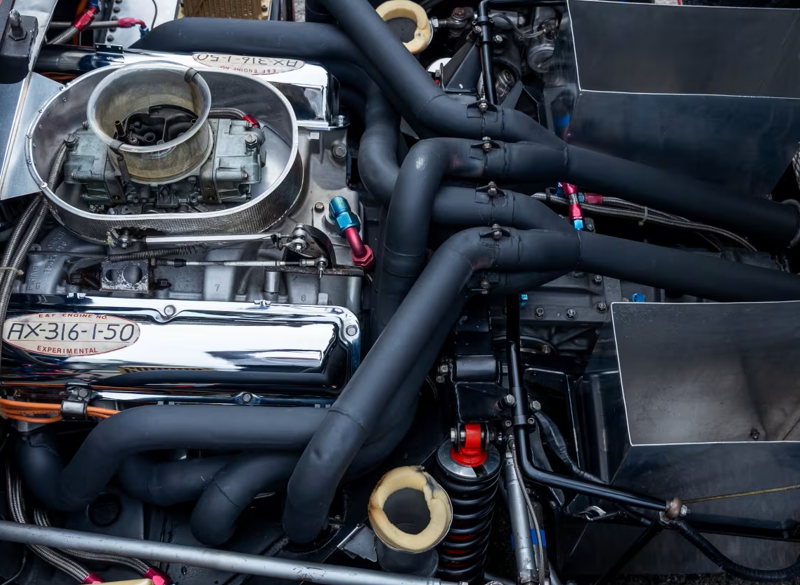
The engine bay is a repository of mid-60s experimental racing technology, preserved in its original configuration:
Experimental Markings: The chrome valve covers feature “E&F Engine No.” plates stamped with AX-316-1-50 EXPERIMENTAL, a signature of Ford’s internal development program.
Induction System: A single high performance four barrel carburetor is housed within a specialized cold air box.
Exhaust Design: The “Bundle of Snakes” headers are finished in a period correct matte black coating, optimizing flow for the 427 CI big block.
Ancillary Components: The bay utilizes anodized blue and red Aeroquip fittings and braided stainless steel lines, which were state of the art for the 1966 season.
| Feature | Standard Ford GT40 MKII | MKII Factory Lightweight (XGT 3) |
| Chassis Material | Standard gauge steel monocoque | Experimental thin gauge steel |
| Roof Construction | Steel | Lightweight Aluminum |
| Suspension | Fixed racing setup | Fully Adjustable (unique to lightweights) |
| Engine | 427 CI FE V8 | Experimental 427 CI (AX series) |
| Transaxle | Kar Kraft T 44 4-Speed | Kar Kraft T 44 4-Speed |
| Fuel System | Standard racing cells | Le Mans fuel crossover tanks |
Classic Car Appraisals for Collector and Historic Vehicles
Vehicles like the Shelby GT350H require an appraiser who understands originality, documentation, and collector market behavior. Auto Praise provides independent classic and collector car appraisals completed by certified auto appraisers with decades of experience in high-value and historically significant vehicles.
Conclusion
At a final price of $12,375,000, which of course includes the buyer fee, the sale of this 1966 Ford GT40 MKII chassis number XGT 3 cements its status as a “unicorn” in the collector world. As the definitive reference example for the model, it offers an unfiltered look at the machine that finally conquered Le Mans for America.