
 Call us now:

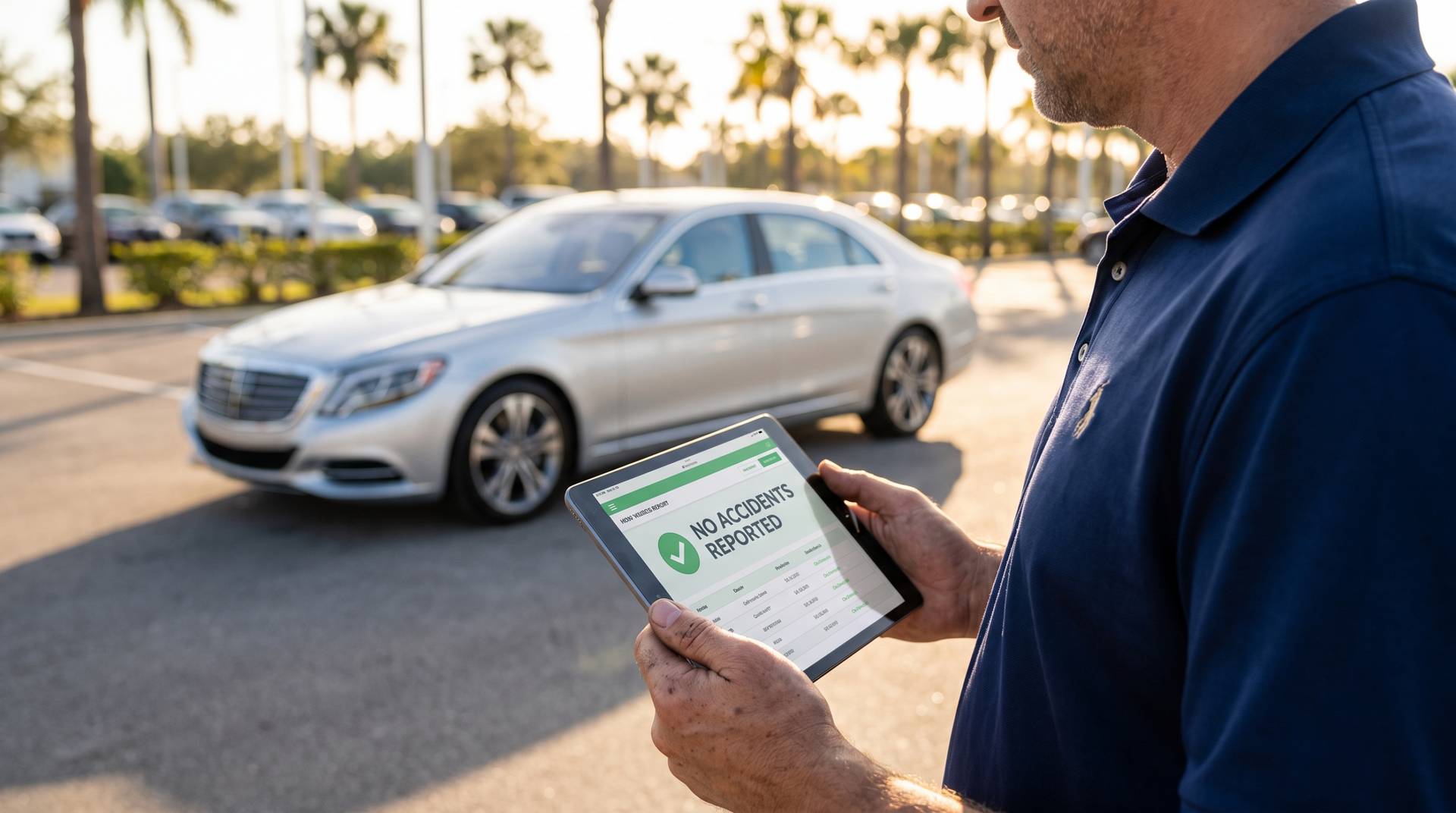
How accurate is Carfax? It’s accurate about what gets reported to it, and incomplete about everything that doesn’t. Carfax doesn’t inspect vehicles or independently verify conditions. It compiles records that insurers, DMVs, auction houses, and repair facilities choose or are required to send it, which means the report is only as complete as that reporting chain, and that chain has real, well-documented gaps.
TL;DR: How accurate is Carfax on any given report? Only as accurate as the records that were actually sent to it, not on independent verification of the vehicle. A clean report means no record was found, not that no accident occurred. Before relying on a Carfax report to buy, sell, or evaluate a claim, understand how accident history reports actually anchor a vehicle’s resale value and where the report itself can fall short.
What Is a Carfax Report, and What’s It Supposed to Show?
A Carfax report is a compiled history built from third-party records tied to a vehicle’s VIN: title status, reported accidents, odometer readings, service records, and ownership changes. It’s designed to flag known events, not to inspect or grade the vehicle’s current condition, which is a distinction that matters more than most buyers realize.
The report’s value comes from aggregation, pulling together records that would otherwise sit in separate DMV, insurer, and auction databases. What it can’t do is create a record where none exists. If an event never reached one of Carfax’s data sources, the report has nothing to show, and it will read as clean regardless of what actually happened to the vehicle.
How Accurate Is Carfax, Really?
Carfax is accurate in the narrow sense that it reliably reports what its data sources send it. It is not accurate in the broader sense buyers often assume that a clean report confirms an undamaged vehicle. The report reflects reporting completeness, not physical condition.
So how accurate is Carfax in practice? The real answer comes down to a distinction most people never get explained to them: a report can be 100% correct about the records it holds while still being incomplete about the vehicle’s actual history. Both things are true at once, and treating a clean report as proof of a clean vehicle is the mistake that causes the most disputes later, particularly around structural damage, which doesn’t always leave the paper trail owners assume it does.
How Does Carfax Get Its Information?
Carfax sources its records primarily from insurance companies, state DMV title and registration systems, auto auctions, and some repair and service facilities that choose to report. Each source only contributes what it’s set up to transmit, and none of them are required to report every category of event.
This is really the answer to how Carfax gets its information: an insurer transmits a record when a claim is filed and processed through its system. A DMV transmits a title status change like salvage or rebuild. An auction transmits a condition disclosure at the point of sale. If a repair happens outside any of those systems, paid out of pocket, done by an independent shop with no insurance involvement, or occurring in a jurisdiction with lighter reporting requirements, there’s often no transmission point for it to reach Carfax through at all.
Common Gaps: What Carfax Doesn’t Catch
Several categories of damage routinely miss the reporting chain entirely. Out-of-pocket repairs never generate an insurance record. Independent body shop work outside a claim process often isn’t tied to a title or insurance database. Minor accidents that owners choose not to report to avoid a premium increase leave no trace. Out-of-state accidents can also fall through if reporting integration between states or agencies is incomplete.
How accurate is Carfax on this specific point? Reliable about processed claims, silent about repairs that never generated one. The pattern worth noticing: these gaps skew toward exactly the kind of damage that’s easiest to hide and often most consequential to value. A driver who pays cash for a bumper repair after a minor collision has no motivation to create a record, and the shop performing the work usually has no reporting obligation either. That combination is common enough that “no accident reported” and “no accident occurred” should never be treated as interchangeable statements.
What a Carfax Accident Report Actually Includes
A Carfax accident report typically includes the date range of a reported event, the general severity category if available, airbag deployment status, and whether the claim resulted in a total loss determination or a repair. It generally does not include repair invoices, the shop’s actual scope of work, or an independent condition assessment after the repair was completed.
How accurate is Carfax on repair quality specifically? Not very. The report can confirm that a claim was filed and processed, but it has no visibility into whether the work itself met any particular standard, which is a meaningful limit for anyone trying to use the report to judge repair quality rather than just confirm an event occurred. A carfax accident report can confirm that an accident happened and roughly how severe the reported claim was, but it can’t tell you whether the repair met OEM standards or whether structural components were properly restored. That gap is exactly where a professional inspection, not a database lookup, becomes the more reliable source.
Why a Missing Carfax Claim Doesn’t Mean a Clean History
The absence of a carfax claim on a report reflects the absence of a transmitted record, not necessarily the absence of an accident. This distinction matters most in a dispute, because insurers and buyers alike sometimes treat a clean report as if it settles the question of vehicle condition, when it only settles the question of what got reported.
For an owner pursuing a diminished value claim, this cuts both ways. A missing carfax claim on a vehicle that was genuinely repaired well shouldn’t be treated as evidence against the claim; the claim rests on the accident and repair itself, documented independently, not on whether Carfax happened to pick it up. Conversely, a report showing no accident is never grounds to assume a vehicle has no history worth investigating before a purchase.
Get a Diminished Value Appraisal Review
If you believe an accident has reduced your vehicle’s resale value even after repairs, Auto Praise can provide an independent appraisal to establish what your vehicle is actually worth.
What This Means When You’re Buying, Selling, or Filing a Claim
How accurate is Carfax for your specific vehicle? That depends entirely on which of these sources ever generated a record for it. For a buyer, a clean Carfax report is a reasonable starting point, not a substitute for an independent inspection, especially on a vehicle where the price seems better than comparable listings. For a seller, a clean report doesn’t guarantee full value if undisclosed history surfaces later through other means. For someone filing a claim, the report is one input among several, not the deciding document.
Which Records Typically Reach Carfax, and Which Don’t
| Record Source | Typically Reaches Carfax? | Why It Might Not |
| Insurance-processed claim | Usually | Requires the claim to be filed and fully processed through the insurer’s system |
| State DMV title change (salvage, rebuilt) | Usually | Depends on that state’s reporting integration with Carfax |
| Auto auction condition disclosure | Usually | Only applies if the vehicle passes through an auction |
| Out-of-pocket or independent shop repair | Rarely | No insurer or DMV transmission point exists for the repair |
| Unreported minor accident | Rarely | No claim was filed, so no record was ever generated |
| Out-of-state accident | Inconsistent | Depends on reporting integration between the two states involved |
How accurate is Carfax, in the end? As accurate as the reporting chain behind it, and not a substitute for an inspection of the vehicle itself. The report is a genuinely useful starting point for buyers, sellers, and claimants, but it answers “what got reported,” not “what happened to this car.” When the two questions matter enough to get right, particularly in a diminished value appraisal, an independent inspection is the tool built to answer the second one.
Frequently Asked Questions
How accurate is Carfax compared to other vehicle history services?
Carfax and competitors like AutoCheck draw from overlapping but not identical data sources, so accuracy varies by which records a given vehicle’s history happens to touch. Neither service independently verifies a vehicle’s current condition; both report only what’s been transmitted to them.
Can a car have accident damage with no Carfax report showing it?
Yes. If a repair was paid out of pocket, done outside an insurance claim, or occurred somewhere with limited reporting integration, the vehicle can have real accident history with nothing appearing on the report.
Does a rebuilt or salvage title always show up on Carfax?
In most cases, yes, since title status changes typically come through state DMV records that Carfax sources directly. Timing can lag depending on how quickly the state processes and transmits the title change.
What does it mean if a carfax accident report shows “unknown severity”?
It generally means the source that reported the claim didn’t transmit a severity classification, not that the accident was necessarily minor. Treat an unknown severity listing as a prompt for further documentation, not as a negative finding.
Should I get an independent inspection even if the Carfax report is clean?
Yes, particularly before a private-party purchase or before assuming a vehicle has no history worth documenting for a claim. A clean report reflects reporting gaps as easily as it reflects a genuinely undamaged vehicle, and only a physical inspection resolves which one you’re looking at.
Why would an insurer dispute a diminished value claim using a Carfax report?
Some insurers point to a report showing no severe accident classification as grounds to minimize a settlement, even when the actual repair documentation and independent inspection tell a different story. The report is one data point, and it shouldn’t override documented repair and appraisal evidence.
Is a Carfax report considered reliable enough to use in a legal or insurance dispute on its own?
Generally not on its own. How accurate is Carfax in that setting? Useful as supporting context, but a report reflects transmitted records rather than verified condition, so disputes typically rely on repair documentation and an independent appraisal alongside it rather than the report by itself.