
 Call us now:

A 2016 Lamborghini Huracán LP 580-2 RWD was involved in a collision on a Miami expressway and declared a total loss. The insurer’s Market Valuation Report, generated through the carrier’s automated valuation software, established a base vehicle value of $161,866, derived from just two comparable vehicles sourced from Sioux Falls, South Dakota, 1,539 miles from Miami. An independent total loss appraisal by Auto Praise concluded the vehicle’s actual cash value at $225,794, supported by three comparables selected for trim equivalency, mileage proximity, and a detailed OEM options analysis. After retaining Auto Praise as an independent auto appraiser and invoking the appraisal clause, the final appraisal award came in at $210,822.21 — a recovery of $48,956 above the insurer’s base vehicle value.
Case Overview
| Field | Detail |
|---|---|
| Vehicle | 2016 Lamborghini Huracán LP 580-2 RWD |
| Exterior Color | Blue |
| Engine / Drivetrain | 5.2L V10 / Rear-Wheel Drive, Dual Clutch |
| Mileage at Time of Loss | 55,000 miles |
| Location | Miami, FL |
| Service Type | Independent total loss appraisal / Appraisal clause |
| Insurer’s Base Vehicle Value | $161,866.00 |
| Auto Praise Independent Appraisal Value | $225,794.00 |
| Final Appraisal Award | $210,822.21 |
| Recovery Above Insurer’s Base Offer | $48,956.00 |
Outcome at a Glance
|
Amount |
|
|
Insurer’s Base Vehicle Value |
$161,866 |
|
Auto Praise Independent Appraisal |
$225,794 |
|
Final Appraisal Award |
$210,822 |
|
Recovery Above Base Offer |
$48,956 |
Florida Total Loss Appraisal & Claim Support
- Professional Authority: I-CAR Platinum & IACP Certified Appraisers with Florida 6-20 Adjuster Licensing.
- Industry Credentials: Over 30 years of specialized automotive and insurance claims experience.
- Valuation Experts: Independent Actual Cash Value (ACV) reports designed to accurately value your vehicle.
- Proven Reputation: Five-Star Rated Florida independent appraisal firm providing statewide remote and mobile support.
The Vehicle and the Loss: Miami Context
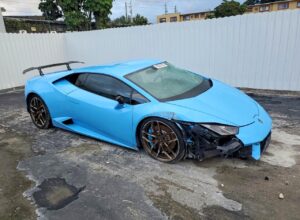
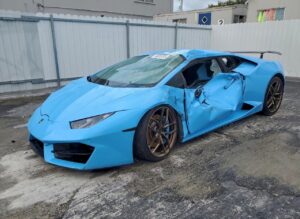
The 2016 Lamborghini Huracán LP 580-2 was garaged in Coral Gables and was involved in a two-impact collision on a Miami expressway. The vehicle was struck on the right front, came to rest in the roadway, and was subsequently struck by a garbage truck on the driver’s side, producing the extensive lateral and structural damage visible in the scene photographs. The vehicle was declared a total loss.
Coral Gables sits at the core of Miami’s luxury and exotic vehicle market. The neighborhood borders the Miracle Mile commercial corridor along Coral Way, connects to US-1/South Dixie Highway, and sits immediately south of the SR-836 Dolphin Expressway interchange, one of Miami-Dade County’s highest-traffic arterial corridors. The Palmetto Expressway (SR-826), which intersects I-95 just north of Coral Gables, is among the most frequently documented locations for high-speed collisions involving performance vehicles in South Florida.
The Miami exotic vehicle market is one of the most active in the country. Lamborghini, Ferrari, and McLaren ownership concentrations in Miami-Dade and Broward counties are among the highest nationally. Brickell, Coconut Grove, Coral Gables, and Key Biscayne collectively represent a dense population of ultra-high-value vehicles. Comparable inventory for a 2016 Huracán LP 580-2 in this market reflects pricing that is consistent with, or above, national figures, driven by regional demand, low local depreciation rates on exotics, and a buyer pool that is both large and financially qualified.
A 2016 Lamborghini Huracán LP 580-2 with 55,000 miles is not a common vehicle on the open market. The LP 580-2 is the rear-wheel-drive variant of the Huracán, a distinct model from the LP 610-4 AWD version, with different dynamics, lighter weight, and a separate collector following. Finding true trim-equivalent comparables for this specific vehicle requires a nationwide search and careful attention to factory option content, which varies substantially from unit to unit and materially affects market value.
The Insurer’s Valuation — What the MVR Showed
The insurer used its automated Market Valuation Report to establish a base vehicle value of $161,866. The report used only two comparable vehicles, both sourced from a single dealership group in Sioux Falls, South Dakota, listed as “Dealer Quotations” with no stock numbers and a distance of 1,539 miles from Miami.
|
Comp |
Source Type |
Location |
Distance from Miami |
|
Comp 1 |
Dealer Quotation |
Sioux Falls, SD |
1,539 miles |
|
Comp 2 |
Dealer Quotation |
Sioux Falls, SD |
1,539 miles |
Both comparables were listed at exactly $161,866, producing a straight average of $161,866 with zero adjustments applied for mileage, options, condition, or geography. When local and regional comparable inventory is not available, it is standard practice to source comparables from a wider geographic area and apply appropriate market adjustments. The question in this case was whether dealer quotations from a single source 1,539 miles away, with no documented adjustments, accurately reflected the market for a 2016 Lamborghini Huracán LP 580-2 in the Miami market.
Prior damage deduction. The insurer applied a prior damage deduction of $39,823.03, reducing the adjusted vehicle value from $161,866 to $122,042.97 before tax. This deduction was applied by the carrier as part of its settlement calculation. The independent appraisal addresses the base value of the vehicle as it existed prior to the loss, the question of how prior damage interacts with the settlement calculation is governed by the policy terms and is separate from the question of what the vehicle was worth.
The OEM options gap. The insurer’s comparable selection did not account for the subject vehicle’s documented OEM factory option content. The subject vehicle carried $59,200 in OEM options, a figure material to value in the exotic segment, where factory-installed options on Lamborghini vehicles command significant premiums in the secondary market. Neither comparable in the MVR was analyzed for option content equivalency.
The Auto Praise Independent Appraisal — Our Process
Comparable selection for an exotic vehicle. Finding true comparables for a 2016 Lamborghini Huracán LP 580-2 requires a nationwide search. This is not a vehicle with high regional inventory — there are no zip-code-adjacent comparables for a 9-year-old exotic supercar. What matters is trim equivalency, mileage proximity, accident history, and, critically — factory option content. I sourced three comparables, all LP 580-2 RWD units, from the broader U.S. market:
|
Comp 1 |
Comp 2 |
Comp 3 |
|
|
Location |
Boynton Beach, FL |
Vienna, VA |
Wellesley, MA |
|
Mileage |
42,356 |
13,152 |
28,812 |
|
List Price |
$199,900 |
$204,990 |
$209,597 |
|
Equipment Adjustment |
+$40,763 |
+$9,633 |
+$26,224 |
|
Accident Adjustment |
— |
— |
−$10,479 (1 accident, 5%) |
|
Mileage Adjustment |
−$3,793 |
−$12,554 |
−$7,856 |
|
Final Adjusted Value |
$236,870 |
$202,069 |
$238,444 |
The OEM options analysis. The subject vehicle carried $59,200 in factory-installed options. This is a defining characteristic in the exotic segment, buyers and dealers price Lamborghini units in substantial part based on their option content. Each comparable was analyzed against the subject vehicle’s option list. Equipment adjustments were calculated at 89.2% of the difference between the subject vehicle’s option value and each comparable’s option value, a methodology consistent with market research on option value retention in this segment. The subject vehicle’s options premium over its comparables ranged from $9,800 to $45,700, producing meaningful upward adjustments that the insurer’s automated report entirely omitted.
Accident history adjustment. Comp 3 had one reported prior accident. A 5% downward adjustment was applied to that comparable to account for the value difference between a clean-history vehicle and one with an accident record. The subject vehicle had a clean history at the time of loss.
Average comp value and MSRP context. The three adjusted comparable values averaged $225,794. The subject vehicle’s original MSRP was $262,495. At $225,794, the independent appraisal conclusion represents approximately 86% of the vehicle’s original MSRP, consistent with the depreciation profile of a 9-year-old, 55,000-mile exotic with no prior accidents and substantial factory option content.
The result: Auto Praise concluded the actual cash value of the 2016 Lamborghini Huracán LP 580-2 at $225,794, effective the date of loss, prepared in conformity with USPAP. This was $63,928 above the insurer’s base vehicle value, a gap large enough to make appraisal clause invocation clearly warranted.
The Appraisal Clause Process
The appraisal clause is a provision in most first-party auto insurance policies that allows a policyholder to formally dispute the insurer’s valuation when the two parties cannot reach agreement. It is available only to a first-party insured, meaning the vehicle owner must be filing the total loss claim through their own insurance policy. On a third-party claim, where the vehicle owner is filing against another driver’s carrier, the appraisal clause is not available, and the vehicle owner must pursue other means to challenge an unsatisfactory offer.
In this case, the vehicle owner invoked the appraisal clause under their own policy and named Auto Praise as their appointed appraiser. The carrier appointed its own appraiser. As required by Florida statutes and standard policy language, a neutral umpire was elected at the outset of the process — available in the event the two appraisers could not reach agreement. The two appraisers reviewed their respective findings and worked toward resolution. The process produced a binding appraisal award.
Final Appraisal Award: $210,822.21
The appraisal award is the figure the insurance carrier is required to settle the claim for under the policy.
Outcome Summary
|
Insurer’s Base Vehicle Value |
$161,866.00 |
|
Final Appraisal Award |
$210,822.21 |
|
Recovery Above Insurer’s Base |
$48,956.00 |
The appraisal award of $210,822 represented nearly $49,000 more than the insurer’s initial base vehicle value, on a vehicle whose entire valuation had been built on two identical dealer quotations from a single source, 1,539 miles from the insured’s location, with no option adjustments applied.
What This Case Illustrates
Two comparables from one distant source is not a market. The insurer’s valuation was built entirely on two dealer quotations from the same location in South Dakota, with identical prices, no adjustments, and no stock numbers. For an exotic vehicle like the Lamborghini Huracán LP 580-2, that methodology does not produce a defensible market value. It produces a number. A proper independent appraisal for a low-volume exotic requires a nationwide search with documented, stockable comparables, analyzed for trim, mileage, history, and option equivalency.
OEM factory options drive value in the exotic segment. A Lamborghini Huracán is not a commodity vehicle. Two units of the same trim level can differ by $50,000 or more in market value based solely on their factory option content. The subject vehicle carried $59,200 in documented OEM options. None of the insurer’s comparables were analyzed for option equivalency. An independent appraisal that ignores this variable will be inaccurate, sometimes by a margin that dwarfs the cost of obtaining the appraisal itself.
Accident history is a documented value factor. When selecting comparable vehicles for an exotic vehicle appraisal, prior accident history is a critical variable. A clean-history Huracán and one with a reported accident are not equivalent comparables. Where a comparable with a prior accident must be used due to inventory limitations, a documented adjustment is required. The independent appraisal in this case applied a 5% deduction to the accident-history comparable, a conservative and defensible adjustment.
The gap between automated and independent valuation is largest on exotic vehicles. Automated valuation tools are designed for high-volume vehicles where comparable inventory is abundant and option differences are modest. For low-volume exotics, the same methodology produces valuations that may be far removed from actual market pricing. The $63,928 gap between the insurer’s base value and the independent appraisal conclusion in this case illustrates what that structural limitation looks like in practice.
The appraisal clause resolved a nearly $50,000 dispute without litigation. The appraisal clause process produced a binding award of $210,822 — $48,956 above the insurer’s starting position. The process worked as the policy designed it to work: a structured, evidence-based resolution that did not require the vehicle owner to sue their insurance company to recover fair value.
Frequently Asked Questions
How are exotic and supercar total losses valued differently from regular vehicles?
Exotic and supercar total losses require a more intensive comparable analysis than high-volume vehicles. Inventory is thin, options vary dramatically from unit to unit, and the buyer pool is specialized. Automated valuation tools are calibrated for high-volume vehicles; they can produce significantly inaccurate results on low-production exotics where comparable inventory is scarce and option premiums are large. An independent total loss appraisal for an exotic vehicle requires a nationwide comparable search, a documented OEM options analysis, careful attention to accident history on each comparable, and familiarity with how the segment prices these variables in the secondary market.
What are OEM factory options and why do they matter in a Lamborghini total loss claim?
OEM factory options are manufacturer-installed features selected at the time of original purchase, things like exterior paint finishes, interior packages, carbon fiber trim, upgraded audio, sport exhaust, and performance packages. On a Lamborghini, these options are not interchangeable between vehicles, and they carry measurable value in the secondary market. Two Huracán LP 580-2 units with identical mileage and identical base trim can differ by $30,000 to $60,000 in market value based purely on their option content. A total loss valuation that uses comparables without analyzing and adjusting for option differences will produce an inaccurate result. See our guide on comparable vehicles in total loss valuation for more on how adjustments work.
Can the appraisal clause be used for a Lamborghini or other exotic vehicle total loss in Florida?
Yes. The appraisal clause is a standard provision in most first-party Florida auto insurance policies and applies regardless of vehicle type or value. If you are a first-party insured, meaning you are filing the claim through your own policy, and you disagree with the insurer’s total loss valuation, you have the right to invoke the appraisal clause. The clause is not available on third-party claims, where you are filing against another driver’s insurance. For more detail on your rights under Florida law, see our Florida Total Loss Law page.
Why would an insurer use comparable vehicles from 1,500 miles away for a Miami total loss claim?
For low-volume exotic vehicles, local comparable inventory is often unavailable. When no matching vehicles are listed within the local market, it is standard and appropriate practice to expand the search radius nationally and apply market adjustments to account for geographic differences. The issue in this case was not that out-of-area sources were used, it was that only two quotations from a single distant source were used, with identical prices, no stock numbers, no mileage adjustments, and no option analysis. That is not a market; it is a single data point with no verification. A properly conducted independent appraisal uses multiple confirmed, stockable comparables with documented adjustments.
How much can an independent appraisal recover on a luxury or exotic car total loss?
It depends entirely on the gap between the insurer’s automated valuation and the vehicle’s actual market value. For high-volume vehicles, that gap is typically in the low thousands. For exotic and specialty vehicles, where automated tools are least accurate and option content is most variable, the gap can be substantially larger. In this case, the recovery above the insurer’s base value was $48,956. If you believe your total loss offer seems low, the first step is a review of the insurer’s Market Valuation Report and comparable selection. Auto Praise can review the report and identify whether there is a valid basis to challenge the offer.
Do I need a physical inspection for a Lamborghini total loss appraisal?
Not necessarily. Most Auto Praise total loss appraisals are completed as desk reviews using documentation, the insurer’s MVR, vehicle history records, OEM window sticker, and market data, along with photos provided of the vehicle. When documentation is thorough and the vehicle’s condition and option content can be established from available records, a desk review is sufficient to produce a USPAP-compliant independent appraisal. In this case, the appraisal was completed as a desk review using available documentation and photos.
Free Claim Review — Fort Lauderdale and Broward County
If the insurance company’s total loss offer seems too low, Auto Praise can review the Market Valuation Report and identify errors that may be affecting your settlement amount. We assist Florida vehicle owners statewide, including owners of exotic, luxury, and specialty vehicles, by reviewing comparable vehicles, adjustments, options, condition ratings, and valuation methodology.
A free claim review can help you understand whether there is a valid basis to challenge the offer and pursue a better settlement. If your insurer undervalued your car, an independent auto appraiser can document what it was actually worth.
Auto Praise handles total loss appraisals and appraisal clause assignments for Miami vehicle owners, including exotic, luxury and high-value vehicles.
Call 754-210-9807 for a Free Review Florida Licensed Adjusters • I-CAR Platinum Certified • IACP Certified Auto Appraisers